

Our Multigenerational Living Home Made the Boston Globe—Again
Article may have affiliate links. If you make a purchase, I may earn a tiny commission at no extra cost to you. Big thanks for supporting my small business.


Eleven years ago, the Boston Globe featured our family when we were four generations under one roof—my grandparents, my parents, my son, and me. Back then, we were living in my parents’ house. My ex and I had moved in temporarily when my son was two, but we never left. The sandwich generation multigenerational living setup just worked—financially, logistically, for all of us.
If you’ve been around here for a while, you know what happened next. My parents sold that first house, and my ex and I bought a new multigenerational home with them 50/50. Six months after we moved in, I found myself in a divorce.
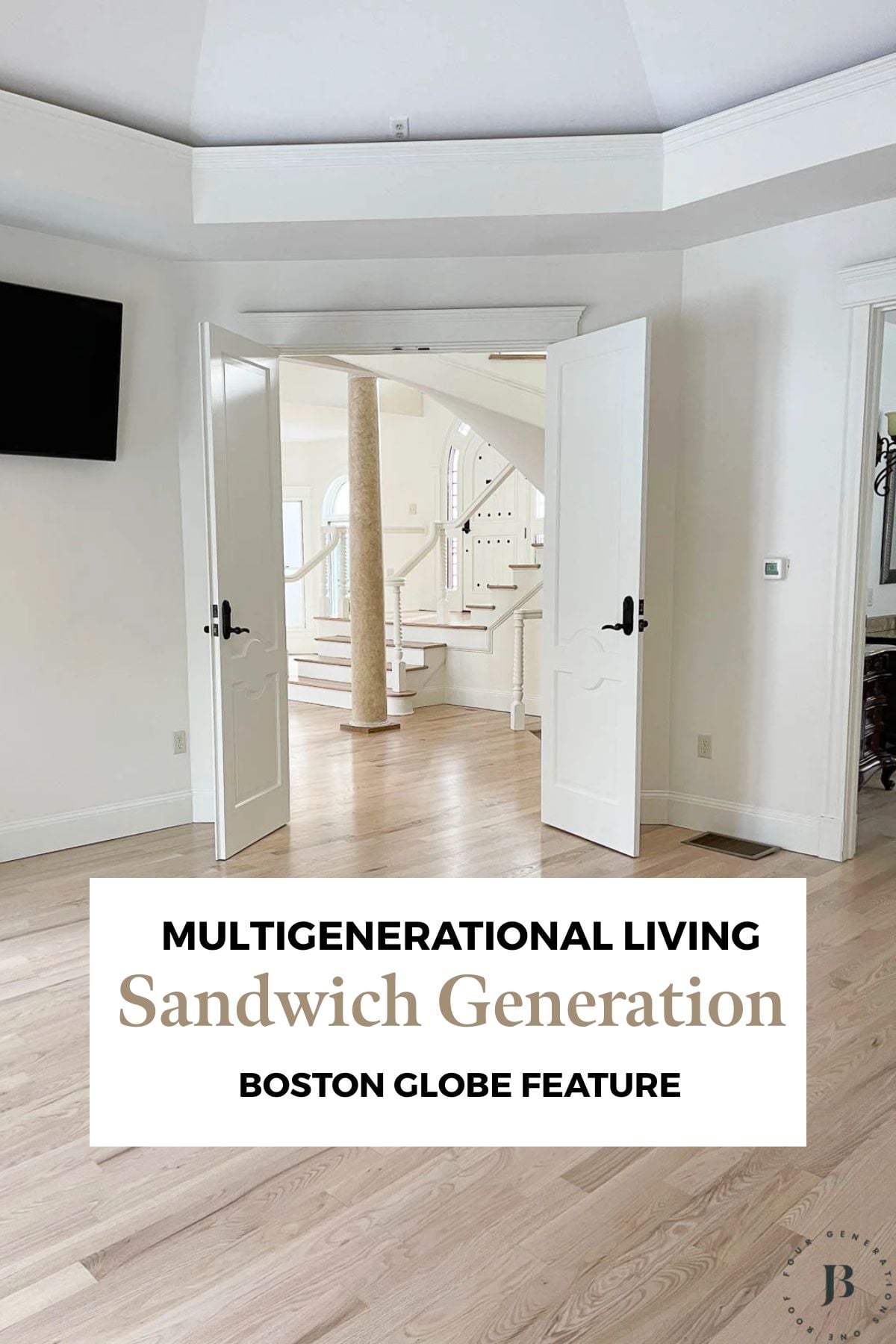
Fast forward to last week: the Globe featured us again. This time, the angle was the sandwich generation! Gen Xers like me who are juggling aging parents on one side and teenage or adult kids on the other. Three generations now, plus my fiancé Jim, in a house we’ve modified over the years to make this actually work.
And honestly? They nailed it!
How Does Multigenerational Living Work?
That’s the question I get asked most often. And the honest answer is: it depends entirely on how intentional you are about the setup.

In most multigenerational living homes, there’s one first-floor master suite. Typically, that goes to the older generation—which makes total sense for accessibility as parents age. My parents have ours, and that’s exactly how it should be.

But here’s what I’ve learned after 14 years: every adult in a multigenerational home needs a space that feels like theirs.
Not just a bedroom.

A space where you feel like a homeowner.
For a while, I hadn’t thought intentionally about carving out my own territory—not because of anything my parents did (they’re genuinely amazing to live with), but because it just hadn’t occurred to me. Once I got intentional about it, everything clicked into place.
How We Created a Second Master Suite
The solution wasn’t complicated once I actually thought about it.
We had a jack and jill bathroom setup on the second floor—two bedrooms connected by a shared bathroom.
One was my bedroom, one was a spare room nobody really used.

So we converted that spare room into a walk-in closet.
Now the bathroom connects our bedroom to our closet instead of to a spare bedroom.
Suddenly, I had a second-floor master suite. Same house, but the layout finally reflected that two families live here, not one family plus guests.

We also created a second TV room.

And we created a teen hangout in the basement for my son, which became honestly one of the best additions we’ve made.

The Globe quoted something I posted on Instagram,
“Privacy and family can coexist. You don’t need a ‘someday house.’ You just need a setup that works for your real life right now.”
I stand by that!
Sometimes learning how to live in a multigenerational home means physically designing your space so every generation feels like they belong there equally. It’s about being intentional from the start.
The Part They Didn’t Cover: The Mindset Piece
The Globe article focused on the practical stuff—the construction, the layouts, the financial logic. All important. But here’s what they didn’t get into: the internal shift that can come with sandwich generation age and all the transitions that happen during this phase of life.
Here’s what I don’t talk about often: after my divorce at 45, I struggled mentally for a solid two to three years.

Some of it still sits with me, if I’m being honest.
I was paying the mortgage. I legally owned half the house. And yet I felt like a failure—like I was somehow behind everyone else my age, like I should be embarrassed to explain my living situation.
And here’s the thing, my parents were incredible during this time.
They were my support system when my son was younger, through the divorce, and after. I was genuinely lucky to have them. Multigenerational living saved me in a lot of ways.
But my brain couldn’t reconcile that with what society had been telling me my entire life.
You know the script: grow up, get a job, move out, become independent. And “independent” meant getting out of your parents’ house. If you didn’t do that, you were failing. You were regressing. You were somehow less than.
That story is garbage, by the way.
But it’s loud.
And when you’re going through a major life transition—divorce, job loss, whatever—that voice gets even louder.
It took one sentence from my therapist (yes I am a big believer in therapy whether you think you need it or not 😉) to start changing everything.
One simple reframe about who actually lives with whom. Same house. Same mortgage. Same family. But suddenly, the power dynamic in my head shifted completely.
That’s what I call the Multigenerational Mindset Shift. And if you’re feeling like you’re 16 again even though you’re paying the mortgage, or if you dread explaining your living situation to other people, or if you feel like you should be further along than you are—there’s a reason for that. And there’s a way through it.

I put together a free guide that walks through the 3 steps that got my brain back on track: The 3-Step Multigenerational Mindset Guide.
It covers the language shift that changed everything for me, how to claim psychological ownership of your space, and understanding the “second adolescence” that happens when you’re living with parents during a major life transition.
What Are the Problems in a Multigenerational Home?
I’ll be honest—I’ve been really lucky. My parents are easy-going, respectful of boundaries, and genuinely great to live with. I wouldn’t want it any other way.

But after 14 years of writing about this topic and hearing from hundreds of families, I can tell you what I see trip people up over and over again.
The money conversation. This is the one most families avoid until it becomes a problem. Who pays for what? How do you split costs when one person makes more than the other? What happens when the water heater breaks—who covers that? What about groceries, utilities, property taxes? And here’s the real question nobody wants to ask: what happens if someone’s financial situation changes?
We have a very simple 50/50 setup that works for us. But I’ve heard from so many families who just… never talked about it. And then resentment builds. Silently. Until it explodes!

Privacy zones. Not having a place to decompress. Feeling like you’re always “on.” Never getting to just exist in your own space without running into someone. This is the thing that makes people feel suffocated even when they love the people they’re living with.
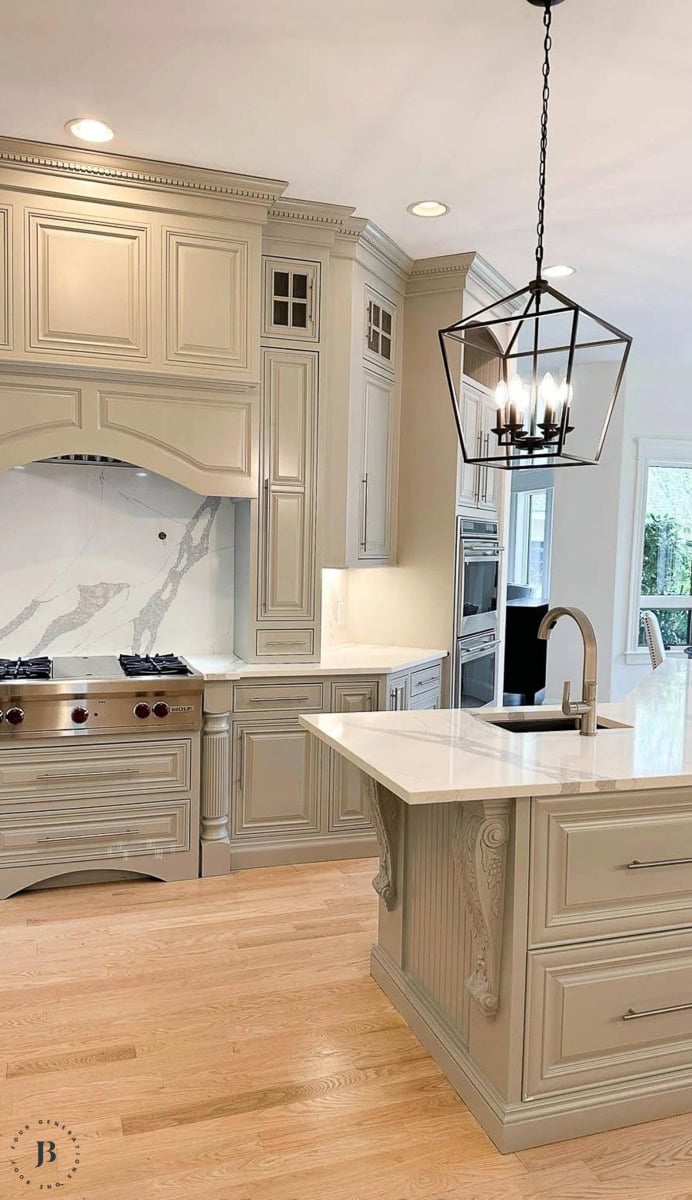
Kitchen logistics. I mentioned this earlier, but it’s worth repeating—80% of multigenerational coordination happens in the kitchen.
Here’s the thing: sandwich generation stress and sandwich generation burnout usually aren’t about one big blowup. It’s about a bunch of small things that were never explicitly discussed, building up over time.

The families who thrive in multigenerational living homes are the ones who get specific about expectations early and revisit them regularly.
If you’re considering moving in with family—or you’re already living together and feeling the friction—there are 11 conversations you need to have. Not eventually. Now!
I put together The Multigenerational Sanity Saver with all 11 non-negotiables. The money conversation (with a template). Privacy zones (even in small spaces). The dishwasher rule. Parenting vs. grandparenting boundaries. The exit plan.

We multigen live because we want to, not out of necessity. But either way—by choice or by circumstance—it’s a financial advantage for both sides when you set it up intentionally.
The physical layout matters. The systems matter. And yes, the mental framework matters too.
I got lucky with my parents—they’re genuinely wonderful to live with and I’m grateful for this setup every day. Multigenerational living gave me a support system during one of the hardest seasons of my life! But even with the best family dynamics, I still had to do my own internal work to feel like myself again. The external setup was great. The internal work took longer.
That’s the piece most people don’t talk about. And honestly, it’s the piece that made the biggest difference for me :).
If you’re navigating multi-gen living, I’d love to hear from you!

Meet Jessica
What started as a hobby, Jessica’s blog now has millions of people visit yearly and while many of the projects and posts look and sound perfect, life hasn’t always been easy. Read Jessica’s story and how overcoming death, divorce and dementia was one of her biggest life lessons to date.
Congrats on being back in the paper. Great article.
This may be me in a few years and you will def be my go-to person!
Hi Kelly! Thank you 🙂 Are you guys thinking of all under one roof or compound style with an ADU?