

How Much Does a Split Level Addition Cost? 7 Key Factors To Consider (2026)
Article may have affiliate links. If you make a purchase, I may earn a tiny commission at no extra cost to you. Big thanks for supporting my small business.

Split level addition costs vary wildly, and here’s why nobody can give you a straight answer, those staggered floor levels create structural challenges that differ from house to house. What makes one addition affordable and another budget-busting? It comes down to seven major factors most homeowners don’t know to ask about until they’re already committed to a contractor.
The biggest mistake? Assuming a split level addition costs the same per square foot as a regular house addition. It doesn’t.

In a nutshell, these items actually determine split level addition costs:
- Foundation condition (can it support more weight or does it need reinforcement?)
- Building out vs. up (one is significantly more expensive)
- Roofline integration with existing staggered levels
- Load-bearing wall locations (they’re not where you’d expect)
- Distance utilities need to travel
- Lot limitations (setbacks, slopes, easements)
- Structural engineering required to connect new space to staggered floors
Why “How Much Does a Split Level Addition Cost?” Is Impossible to Answer with One Number
Split levels are architectural puzzles. Those staggered floor levels mean every addition requires custom engineering solutions.

You’re not just adding a box, you’re figuring out how new space connects to existing levels, whether your foundation can handle it, and how to make the roofline look intentional.
Jim, who specializes in ICF new construction, recently wrapped up a couple of additions using ICF blocks.
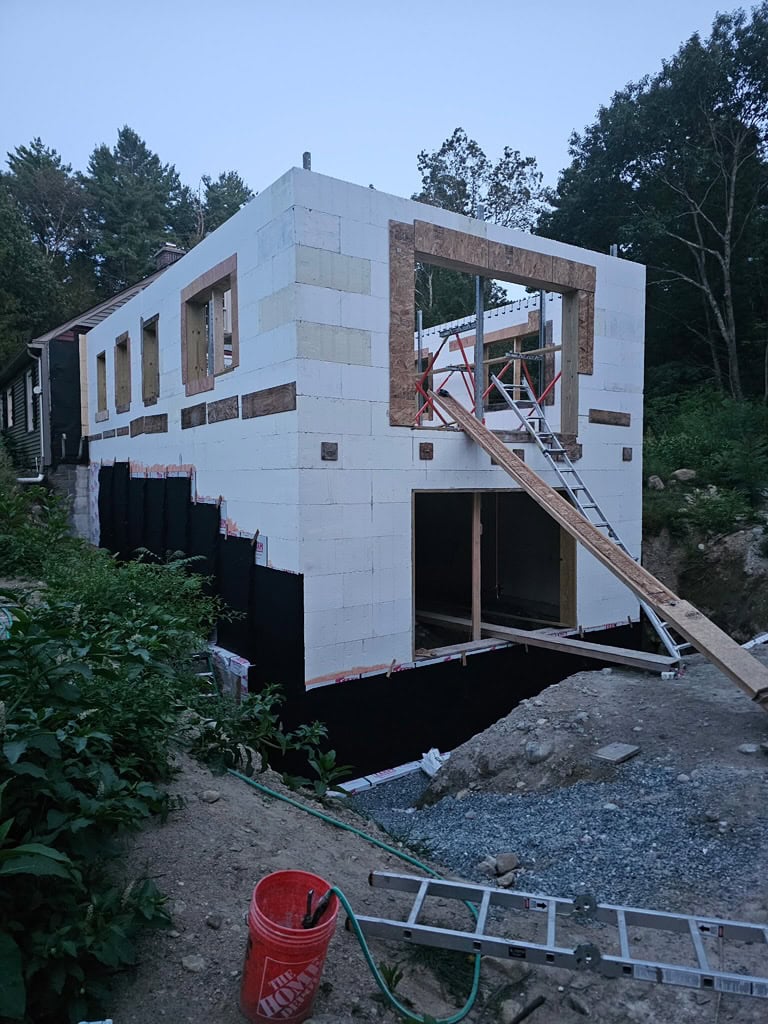
One family bumped out their existing split level to create a large open kitchen and breakfast nook and another client added an entire new garage and room above to their cape style home.
Additions are one of the best ways to increase your square footage without selling and buying a new home.
Factor #1: Building Out vs. Building Up (The Biggest Cost Driver)
This is the single biggest decision that affects your final cost.

Building out means extending your home’s footprint horizontally. This is more straightforward because you’re working with ground-level construction, simpler foundation work, and typically easier utility integration.
Building up means adding a second story. This is more complex because your existing foundation might not support the extra weight, you’re modifying or replacing the roof entirely, structural reinforcement is almost always required, and utilities must extend vertically through existing floors.
When building up makes sense:
- Small lot or setback restrictions prevent building out
- You want to preserve yard space
- You need significant square footage and building out isn’t possible
When building out makes sense:
- You have lot space to expand horizontally
- Your goal is to minimize cost
- You want less structural disruption
On Jim’s split level, he built out, converting a screened porch and opening up a bedroom to create a sunroom/bar space with vaulted ceilings.

That strategy kept costs manageable because he worked with the existing foundation and utilized an existing screen room.
Factor #2: Roofline Integration (Making It Look Intentional)
Bad split level additions look like someone glued a box onto the house. Good ones look like they were always there. The difference? Roofline integration.
What drives roofline costs:
Custom framing – Your addition’s roof needs to tie into existing rooflines at the right angle and height, which means custom calculations and more complex framing.
Multiple roof types – Sometimes one addition involves two or three different roof sections to match existing architecture. More roof sections = more materials, labor, and complexity.
Matching materials – If your split level has different materials on different levels, your addition needs to match both. Sourcing matching materials (especially for older homes) adds time and cost.
Jim’s approach: vault the ceiling wherever possible.

Vaulted ceilings with skylights (like he installed in his kitchen, living room, and sunroom) make spaces feel larger while creating an intentional design feature that makes the addition feel special rather than like an afterthought.

The split level that Jim completely gutted and remodeled a few years ago, involved a addition off one of the bedrooms to create a large closet.
If you own a split level, you know the bedrooms are small and the closets are even smaller!
Factor #3: Load-Bearing Walls in Unexpected Places
Split level load-bearing walls aren’t where logic says they should be. Those staggered floor levels mean structural support runs through the house in patterns that differ from traditional layouts.

If you want to remove walls to create open layouts (common when extending kitchens), you need engineered beams to replace load-bearing walls. An architect designs the beam, a structural engineer stamps the plans, and a contractor installs it.

The trade-off?
Removing walls to create open concept layouts is one of the highest-value updates you can make.
Jim’s split level sold $80,000 over asking price, and he credits much of that to removing the kitchen wall and creating an open space with vaulted ceilings and building an addition for a new larger living room.
Factor #4: How Far Utilities Need to Travel
Your addition needs electricity, HVAC, and possibly plumbing. The question is: how far do those utilities need to travel from their current locations?

Distance from existing systems – Adding space adjacent to your living room means utilities are nearby. Adding space on the opposite end means utilities travel through existing walls and floors—more complex, more expensive.
Plumbing requirements – Additions with bathrooms or kitchens require plumbing, which is more expensive to extend than electrical. Second-story bathrooms are even more complex.
HVAC capacity – Sometimes your existing system can handle additional square footage. Other times, you need to upgrade the entire system.
Electrical panel capacity – Older split levels sometimes have outdated electrical panels that need upgrading to support additional circuits.
Factor #5: Your Lot’s Limitations and Permitting Requirements
Setback requirements – Local zoning determines how close you can build to property lines. If your split level sits close to boundaries, building out might be limited or impossible.
Slope and grading – Split levels were often built on sloped lots. If your lot has significant slope where you want to add space, grading work increases foundation costs.
Permitting timelines – Most additions require permits (structural, electrical, plumbing). Permit approval can take 2-8 weeks depending on your municipality.
The Massachusetts ADU opportunity:
If you’re adding an in-law suite in Massachusetts, the 2025 ADU regulations allow units up to 900 square feet without a special permit! This opens up opportunities for split level additions (or any home) designed for multigenerational living and beyond!

Jim is currently building an ADU for parents that are moving onto the same property as their daughter and while the home isn’t considered an addition (because it’s detached from the main house), it’s a similar process for those looking to add on an in-law suite.

Factor #6: How Much You Can (or Want to) DIY
What professionals should handle:
- All structural work (framing, foundation, load-bearing modifications)
- Roofing, electrical, plumbing, HVAC extensions
- Permit applications and inspections
What handy homeowners can tackle:
- Interior painting
- Installing trim, baseboards, and molding
- Light fixture installation (after electrical is roughed in)
- Flooring (depending on type)
- Basic landscaping cleanup
Handling finishes yourself can reduce total project costs by 10-15%—meaningful on a large addition, but not going to turn an expensive project into a cheap one.
Different Addition Types and What Drives Their Costs
Bump-out additions (extending existing rooms 3-8 feet) – Smaller scope and faster timelines. Great for master suite space, breakfast nooks, or bathroom expansions.
You can see below that there was a closet added (the bump out) to one of the bedrooms.

Ground-level additions (sunrooms, family rooms, in-law suites) – Requires new foundation but works with existing first-floor level. Utilities often easier to extend than second-story additions. Timeline: typically 2-3 months.
Second-story additions (master suites, extra bedrooms) – Most expensive per square foot. Foundation reinforcement often required, entire roof section needs modification, maximum disruption. Timeline: 4-6 months minimum.
Garage conversions or addition above – Foundation and roof already exist (cost savings). Less structural complexity. Trade-off: you lose garage parking. Typically a faster turnaround as much of the structure is already in place.
The Bottom Line
Split level addition costs vary widely because every house presents different structural challenges, foundation conditions, and integration requirements.
The smartest approach? Focus on understanding what drives costs for YOUR specific situation. Get that structural engineer evaluation early, work with contractors experienced in split levels, and set realistic expectations about timelines and budgets.
A well-designed split level addition can completely transform your home from a dated ’70s relic into a modern space that works for how families actually live today. Jim’s split level proved that—removing walls, vaulting ceilings, and adding intentional space made buyers willing to pay $80,000 over asking (yes, his split sold for well over asking 😉)!

Meet Jessica
What started as a hobby, Jessica’s blog now has millions of people visit yearly and while many of the projects and posts look and sound perfect, life hasn’t always been easy. Read Jessica’s story and how overcoming death, divorce and dementia was one of her biggest life lessons to date.