

New House Build Ideas: Where to Splurge and Where to Save (Checklist)
Article may have affiliate links. If you make a purchase, I may earn a tiny commission at no extra cost to you. Big thanks for supporting my small business.
The best new house build ideas aren’t about spending more, they’re about spending smart. Whether you’re building a single-family home or a multigenerational space for one or more families, the trick is knowing where to invest long-term and where to save without feeling like you’re settling.
After sharing a handful of blog posts about the multigenerational house Jim is wrapping up, many of you have asked for my take on ways to save while building a home.
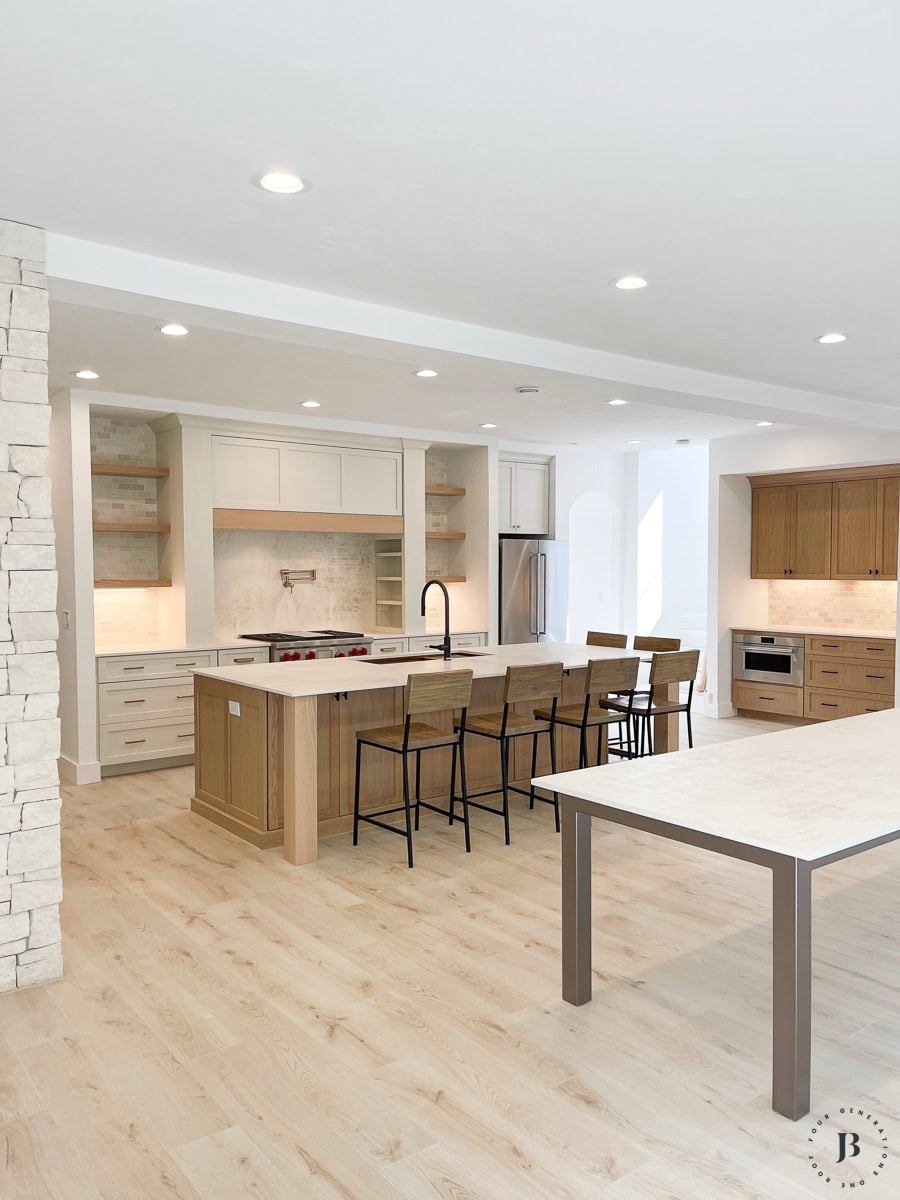
Today, I’m sharing my opinion on where to put your money so your new construction home feels intentional, comfortable, and a little bit custom without blowing the budget.
The kitchen above is part of a modern transitional home Jim built and it’s one of my favorite. (I’ll share a house tour soon!)
What Should I Splurge on When Building a New Home?
For me personally, I think prioritizing high-use areas like kitchens, bathrooms, and flooring for long-term comfort and resale value.
The bathroom tile below was indeed a splurge at the latest modern farmhouse Jim built.

It’s the master bathroom and the client was in love with the tile so she saved in other areas of the home in order to make this bathroom spectacular.
Save on finishes that are easy to upgrade later, like lighting and paint.
Smart Splurges That Add Real Value
When building a new home, it’s way too easy to let emotions take over, and before you know it, you’ve blown your budget on splurges that don’t actually add value.

Trust me, things add up fast!
Our new construction waterfront home in Rhode Island was a clear example of “Jess and Jim, you need to stay in your budget lane!” 😉
Keep a clear list of needs versus wants, and always tack on an extra 5-10% to your budget.
Unless you’ve got serious discipline (and let’s be honest, most of us don’t), you’ll run into things you didn’t plan for and end up making changes along the way.

Budget Hack When Shopping for Finishes:
This is kind of beyond the building a house scope but let’s face it, part of building a house is filling it with furnishings and decor later!
BUT you can also use this hack to find lighting, hardware and other finish items for your build.

Find the item you love online (I loved this chair style above from Crate and Barrel but found on Amazon) and then copy and paste the name of the item in the Amazon search bar, you will be AMAZED at what shows up.
This is how I find so many of my dupes at a ridiculously low price. You can do the same on the Wayfair site but I find Amazon tends to show better results.
You can also do this with the name of the brand you love.
For example, if you love Pottery Barn, type the words “Pottery Barn Sectional” in the Amazon search bar. It will pull up all kinds of brands that are knock offs and dupes.
Deeper Basement Pour (Higher Basement Ceilings)
If having useable basement square feet down the road without a typical lower basement height, consider a basement ceiling height of 9′ or higher.
This basement below that was included in one of Jim’s recent builds was 10′ high and what a difference it made.

The extra height and crazy amount of recessed lights (yes, Jim is obsessed with lighting during his builds) made this entire basement feel like the rest of house and NOT like a basement.
You would never guess that the bathroom below was in a basement.

Solid Core Doors
A small upgrade with a big impact.

They look and feel high-end, offer better sound insulation, and hold up to real-life wear (think kids, dogs, accidental door slams).

Hollow core doors feel cheap the moment you close them.

Solid core?
They have weight, they’re quieter, and they last.
Want to see more of the doors in the house above? Visit our latest multigenerational house and doors from Masonite and Horner Millwork post.
Interior Doors: Hollow vs. Solid Core
- Hollow Core: Light, affordable, but poor sound insulation and prone to damage.
- Solid Core: Heavier, quieter, more durable, and has a premium feel. Worth the splurge in high-traffic or private spaces.
Energy-Efficient Construction (ICF)
As many of you know, Jim builds custom homes using ICF blocks.

ICF stands for Insulated Concrete Forms.
ICF is like building your house with giant Lego blocks made of foam which is the massive insulation, then filling them with steel and concrete to create super strong, well-insulated walls.

The long-term savings on utilities, better storm resistance, and less maintenance over the years is untouchable compared to traditional wood built homes.
If you value energy efficiency and long-term durability, ICF is an excellent investment.

Beyond ICF, invest in quality insulation and low-E, insulated windows.
These save money every single month for decades. Retrofitting structural issues later costs 3-4 times what it would’ve cost initially.
Flooring That Matches Your Life
Luxury Vinyl Plank
If you have pets, kids, or heavy traffic, splurge on quality LVP (luxury vinyl plank).

It’s practically indestructible and now comes in beautiful, design-forward styles.
The LVP plank flooring above featured in the latest ICF multigenerational home that Jim built is virtually indestructible and looks beautiful.
The homeowners have several dogs and lots of foot traffic so they were adamant about the flooring being easy to clean and super durable. This flooring checked off all the boxes!

LVP flooring is not all the same though so be sure to check reviews and installation method as some are better than others.
Engineered Hardwood
For main living areas, hardwood or engineered hardwood resists daily wear and can be refinished multiple times.
Engineered hardwood will typically be more affordable than solid hardwood.

That being said, engineered hardwood, depending on the layer thickness may only have 1 refinish possibility so keep that in mind.
Personally, we do not recommend anything less than a 1/2 inch when choosing engineered hardwood.
The large wide plank flooring above is engineered and beautiful!
Tile Large Scale Planks With Radiant Heat
The house below that Jim built features a tile that looks like plank hardwood.

The homeowner wanted radiant heat throughout their home as well as tile that looked like wide plank wood. This is not a budget friendly flooring option but if you want to splurge, this is a great option!

It’s amazing how much the tile looks like beautiful hardwood planks!
Tile Flooring
In kitchens, bathrooms and mudrooms, durable ceramic tile handles moisture and foot traffic well.

Depending on the look you want, tile floor can accomplish just about any theme.

In both images above, we used black slate tile one in a smaller scale herringbone layout and the other in a larger scale traditional look. Both durable and both easy to clean, especially in mudroom areas.
Tile With Impact
Want that luxury shower look without the slab price tag?
Both bathrooms below feature larger scale wall tile in a bathroom that give the look of a high end full wall stone slab.

Use high-end tile for small areas like the shower floor or niche, and coordinate with affordable wall tile.

You get the visual impact without spending thousands on materials.
Kitchen Cabinets and Countertops
Do NOT skimp on kitchen cabinets and countertops.

Replacing them later means demolition, mess, weeks without a functional kitchen, and costs that’ll make you wish you’d just done it right.

We always recommend quality cabinets (custom or semi-custom if the budget allows) with pull-out drawers, and durable countertops like quartz, quartzite or granite.

One of the biggest regrets you may have down the road?
Not planning for a large butler’s pantry with full cabinetry and countertops.

Bulky appliances cluttering the main kitchen is a complaint we hear constantly so while a pantry may be a “want” it’s definitely something to consider if your budget allows.

Cabinet Overlay Types Explained:
This question comes up all the time and for good reason. The differences are very important especially when you are dealing with thousands of dollars.
- Partial Overlay: Door partially covers cabinet frame. Most common and affordable.
- Full Overlay: Door fully covers the cabinet face. Sleek, more custom look.
- Inset: Door sits inside the frame. Most premium. Requires precise craftsmanship.
If you love the inset look but your budget doesn’t allow for it, be sure to ask your kitchen designer about “getting the look” with partial or full overlay. There are several ways to create a custom look without the hefty price tag.
Electrical and Plumbing Extras
Electrical
A central vacuum system is nice but in my opinion, not necessary. I personally love my Miele vacuum and if it saves me a couple thousand dollars, I would rather put the money somewhere else.
Add extra electrical outlets everywhere: baseboards, closets, islands, inside pantries. One of the biggest areas that everyone forgets is floor outlets!
If you know that you plan on floating a sofa in the middle of your great room (or even a dedicated spot for your Christmas tree), be sure to have floor outlets installed for lamps and electrical cords.
They make “floor” covers for the outlets that literally blend with the flooring so you barely notice them.
Outlets are nearly impossible to add later without opening walls so spend the money during the build.
Plumbing Fixtures
Quality plumbing fixtures matter too.

One thing that I learned the hard way in our own home is the type of water you have can destroy your fixtures.
We are have really hard water and even with a whole house water filtration system, certain fixtures get buildup and it’s impossible to get them clean without scratching them so keep that in mind when you are shopping for fixtures.

Smart Saves That Don’t Feel Like Settling
Square Footage Trade-Offs
Dialing back the overall square footage slightly so you can spend more on finishes where it counts.
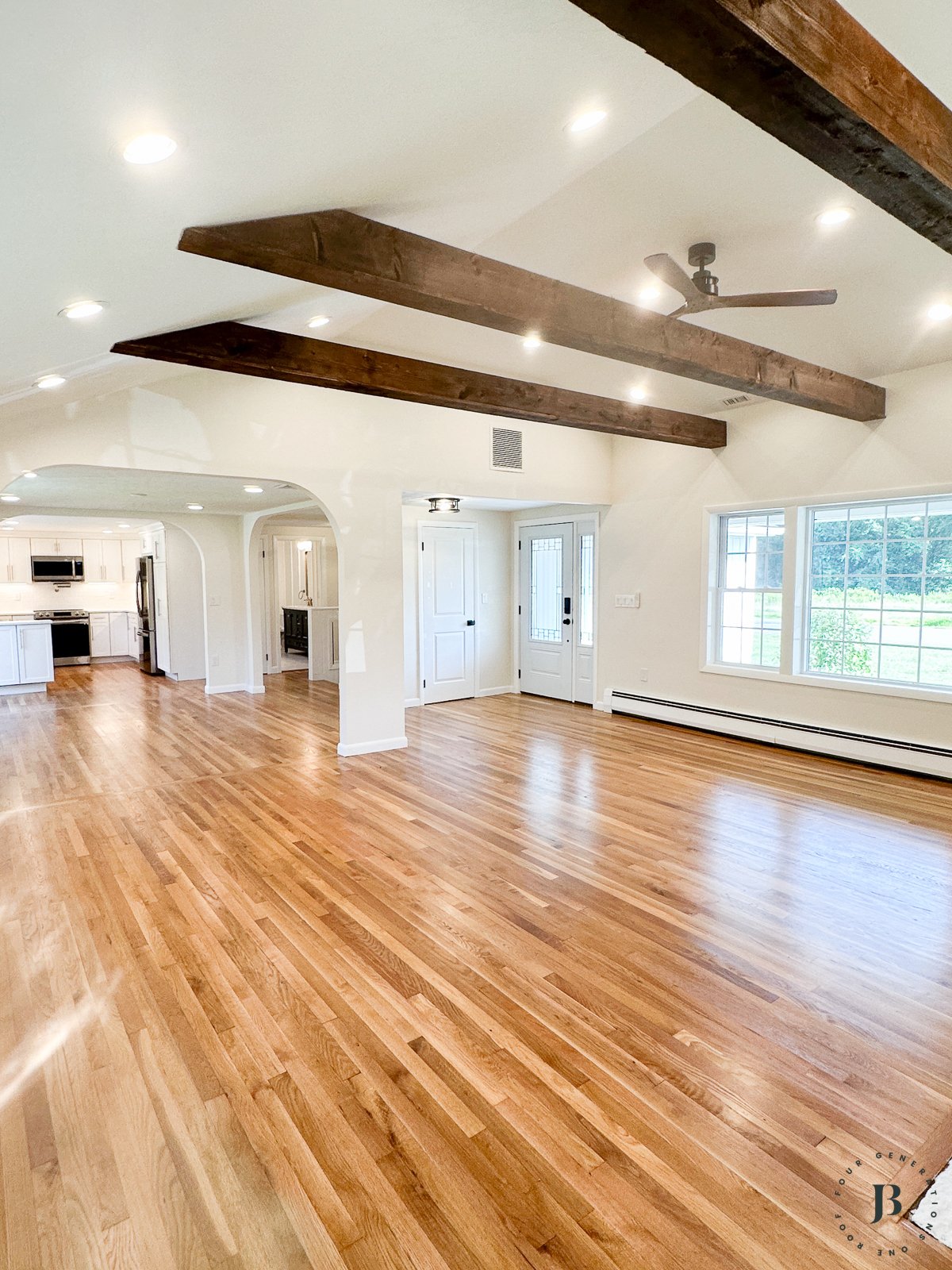
Smaller space, better feel.
Basic carpeting in bedrooms works fine if you are on a budget. It’s not the end of the world to upgrade to hardwood later (yes, baseboards come off and it’s doable without a full renovation).
Lighting Dupe Strategy
Lighting can eat a budget fast.

We pulled off our entire house in Rhode Island with Amazon and Wayfair finds that mimicked designer looks.
Big savings, zero compromise.
Lighting is the number one thing contractors agree you can save on.
Fixtures swap out easily as styles change and stunning options exist at every price point.

Paint and Color Drenching
One cost-saving hack that makes a big impact?
The term color drenching means, painting the walls, ceiling, trim and doors the same color to minimize harsh lines and create a luxurious seamless feel.

By using Benjamin Moore White Dove above on the walls, trim and doors at the home above, the overall feel felt open and airy while keeping the color balanced and cohesive.

It kept things airy, cohesive, and made smaller spaces feel bigger.
Paint is one of the most affordable and easiest changes you make down the road so while it’s important to get it right the first time, especially for a new build, it’s not the end of the world to change it a down the road.
Hardware and Appliances
You don’t need fancy appliances on day one.

Mid-range appliances perform just as well and upgrade easily later.

Hardware (drawer pulls and knobs) swap out for under $100 at anytime.
A hardware hack when picking knobs and pulls for your cabinets is to purchase extra long pulls to give a custom look.
You will see in the 1950s remodeled cape style house kitchen above and 1960’s remodeled ranch home kitchen below, we ordered cabinet pulls significantly longer than the standard size making these mid-range cabinets look and feel high end.

When picking a kitchen appliances, you will typically save money (as we did in both of these kitchens above) by purchasing as a package.
You may sacrifice a particular style cooktop or range for example but if you are on a budget, this is an affordable way to get stylish appliances without blowing your budget.

In our Rhode Island kitchen above, we purchased an appliance package (which saved us money) but we decided to break up the typical microwave above the range layout.
A custom cabinet hood was not in the budget so by adding a stainless hood above the range and placing the microwave in the island, the overall kitchen felt custom without the pricetag.
Appliances can be updated down the road as well so if budget is a concern, this is a great place to save.
Outdoor Features and Finish Carpentry
That outdoor fireplace?
It can wait. Focus on basic landscaping first, then enhance over time as budget recovers.
Coffered ceilings, built-in bookcases, window seats are all gorgeous but not absolutely necessary.
Spend Where It’s Hard to Upgrade Later
Here’s our rule of thumb: if it’s hard to change later, make it count the first time.
- Framing? Yes.
- Insulation? Absolutely.
- Electrical plans and outlets? Get it right the first time.
- Paint, hardware, light fixtures? Easy to upgrade when you’re ready.
Real Life Budgeting: The Emotional Side
Let’s be honest. Splurging and saving is a dance, especially when two people are involved.
When Jim and I were planning the interior purchases at our Rhode Island home, there were definitely moments of compromise (like trading a brand name dreamy chandelier for a quality vanity. Totally worth it!)
The key is to pick your non-negotiables early.
Personally, I think smart construction like ICF, good flooring, a mid-range kitchen design and doors that won’t fall apart in a year.
The goal isn’t perfection on day one.
It’s building a home that works now and grows with you over time (without blowing your budget on things that don’t actually matter).
FAQ & Latest Information
Kitchens, bathrooms, doors, and insulation are key areas where spending more pays off.
Use larger stock cabinets, upscale tile in small doses, and save on lighting with designer dupes.
If you have high-traffic areas, consider luxury vinyl plank (LVP). It’s stylish, durable, and budget-friendly.
If you value energy efficiency and long-term durability, ICF is an excellent investment.

Meet Jessica
What started as a hobby, Jessica’s blog now has millions of people visit yearly and while many of the projects and posts look and sound perfect, life hasn’t always been easy. Read Jessica’s story and how overcoming death, divorce and dementia was one of her biggest life lessons to date.