

ICF Foundation Advantages: Why Your Basement Is Already Half Done
Article may have affiliate links. If you make a purchase, I may earn a tiny commission at no extra cost to you. Big thanks for supporting my small business.

Why is your basement already half done with an ICF foundation? Because the second you pour concrete into those foam blocks, you’ve got built-in insulation AND built-in studs—which means you skip framing, skip buying insulation separately, and skip the moisture nightmares that come with traditional basement finishing.
It’s the ICF foundation advantage nobody talks about upfront!

ICF foundations come with built-in insulation AND built-in studs, which means you screw drywall directly to the blocks without framing, without adding insulation, and without the moisture nightmares that come with traditional basement finishing.

In a nutshell, ICF foundations cut basement finishing time because the insulation and studs are already part of the wall system.
For multigenerational families planning in-law suites, this is a game-changer!
What most people miss:
- You’re not buying insulation twice
- The embedded fastening strips are stronger than you think
- You skip 3-4 major construction phases
What Makes ICF Foundations Different
Traditional concrete foundations are just bare concrete. Cold, uninsulated, and requiring a whole separate finishing process and let’s not forget the concrete wall cracks on a traditional foundation.

ICF foundations are a sandwich: 2.5 inches of foam insulation on each side with a concrete core in the middle.
The efficiency?
ICF foundations dramatically outperform traditional foundations at keeping heat in (or out)—even ones with added insulation.
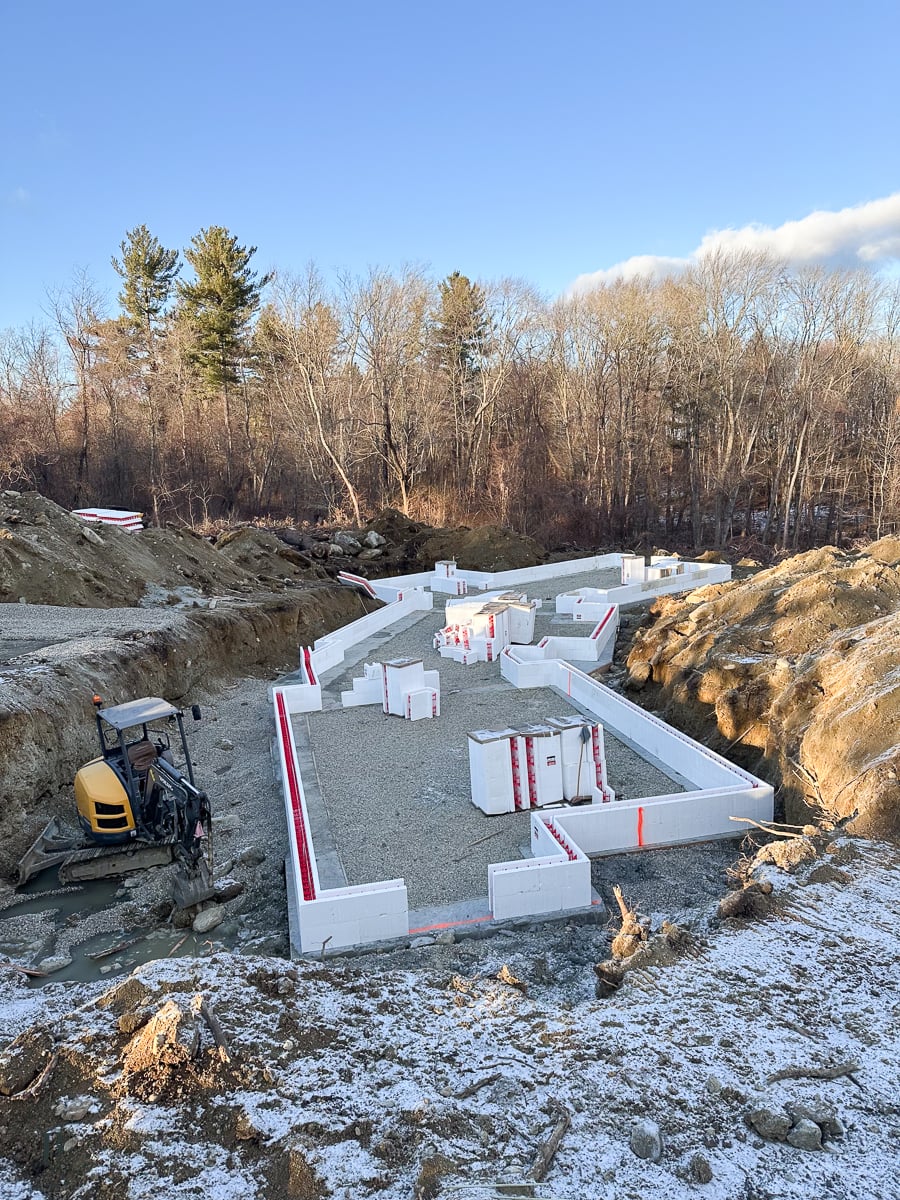
ICF blocks at ground level above are white foam forms with red plastic ties that become your drywall fastening strips. This foam isn’t temporary. It’s your permanent insulation that stays after the concrete pour. Traditional foundations give you none of this.

Those foam blocks stack like Legos and stay there permanently.
With traditional poured concrete, you use temporary forms that get stripped away, then add insulation as a separate step. With ICF, it’s done in one shot.
The Built-In Advantage That Changes Everything
Embedded in the foam every 6 inches are plastic fastening strips—pre-installed studs running vertically up the wall, engineered to hold drywall, cabinets, even TVs.

Traditional basement finishing involves framing walls, adding insulation, installing moisture barriers, then hanging drywall.
With ICF?
Cut foam channels for electrical, screw drywall directly to the embedded strips, and finish. Three construction phases eliminated.

ICF foundation before concrete pour—white blocks with red bracing.
This basement is already 50% finished just by using foam blocks instead of traditional forms. Once concrete fills the cores, you’ve got insulated walls with built-in studs ready for drywall.

The red bracing is temporary. Those white foam blocks? Permanent.
They become your insulation, moisture barrier, and drywall attachment points. Traditional foundations require everything added later.

The foam blocks interlock like Legos. The plastic webbing inside (every 6 inches) creates the fastening strips—your built-in studs.

Why This Matters for Multigenerational Homes
Let’s face it, when you are building or planning for a multi-gen home, you need to utilize every square inch and the basement offers significant options for increased square footage, especially if it’s a walkout basement.
ICF cuts automatically cuts the cost and time of framing, insulation, and moisture control steps.
The image above is the multigenerational home that Jim built and the ICF foundation served as a full 2700 square foot space that adds beautiful extra living space.
Take a tour of the finished multi-gen home with a connected kitchen to see how the interior of an ICF home is no different than a traditional wood built home.
Regardless of whether you are finishing your basement or not, an ICF foundation already takes care of a huge chunk of the refinishing process, just by having an ICF foundation.
Features and Benefits of SuperForm ICF Blocks
There is no denying that ICF delivers significantly higher insulation performance than traditional framing, with whole-wall effective R-values reaching R-29 to over R-40 thanks to continuous insulation and concrete thermal mass.

This increased efficiency can lead to up to 60% savings on heating and cooling costs!
Energy Efficiency
SuperForm ICF blocks combine thick foam insulation with a solid concrete core, helping your home stay warm in winter and cool in summer. This reduces drafts and lowers heating and cooling costs.
Durability and Strength
The steel-reinforced concrete walls create an incredibly strong structure that resists rot, pests, weather, and everyday wear—ideal for long-term, low-maintenance living.

Soundproofing
Dual layers of foam with a concrete center dramatically reduce noise transfer. Perfect for multigenerational homes!
Moisture and Mold Resistance
ICF walls limit moisture intrusion, reducing the risk of mold and dampness, especially helpful if you’re planning to finish a basement or add an in-law suite.

Fast Construction
ICF blocks stack like lightweight building blocks, cutting out multiple steps such as framing, insulation, and vapor barriers. This speeds up build time and lowers labor costs.
Sustainability
High energy performance means your home uses less energy over its lifetime, resulting in lower utility bills and a smaller carbon footprint.

Comfort
Continuous insulation eliminates cold spots and temperature swings, creating a consistently comfortable living environment—especially in basements and walkout levels.
Safety
The fire-resistant concrete core provides added protection and helps increase the amount of time available to exit in case of a fire.

When we build in 2026 with an in-law suite for my parents, ICF isn’t even a question.
The advantages align perfectly with what multigenerational construction requires, a fast timeline, lower finishing costs, better energy performance, and basement space that actually feels like living space instead of just “the basement.
If you’re planning new construction with any intention of finishing the basement, price out both options. The numbers might surprise you!
More ICF Home Posts You Will Love
- Multigenerational home Icf foundation for twin brothers and their wives (new house build)
- Update on the ICF home and foundation for the twins – the foundation walls
- Multi-gen house tour of the finished ICF home for the twins with a connected shared kitchen
- Modern farmhouse ICF foundation walls and concrete pour day
- ICF home features and benefits and why you should consider if building

Meet Jessica
What started as a hobby, Jessica’s blog now has millions of people visit yearly and while many of the projects and posts look and sound perfect, life hasn’t always been easy. Read Jessica’s story and how overcoming death, divorce and dementia was one of her biggest life lessons to date.